


1. Characteristics of pearlescent pigments:
The pearlescent pigment mica flakes are coated with metal oxides to produce pearlescent pigments that can produce pearl luster. It is acid-resistant, alkali-resistant, and temperature resistant up to 750°C. It does not self-ignite and has good stability.

2. Formula:
The amount of pearlescent pigment added depends on the desired effect. For the solid content, the amount of pearlescent pigment added is usually between about 5-10% by weight. For special effects or very thin glossy coatings, the amount may be as high as 30%, but the amount of pigment addition is not recommended because they will hinder the orientation of the flake pigments and cause the gloss loss of the coating. Sometimes only 1%-1.5% of the pearlescent pigments by weight of the solids are needed to make the varnish coating more translucent.
3. Wetting and dispersing:
In order to make the dispersion of pearlescent pigments easier, the pigments can be pre-wetted. The wetting time is more than 20 minutes. First, it is recommended to mix the powdered pigment with a part of the liquid system, or a compatible solvent, diluent or plasticizer to form a slurry, and then stir the slurry into the rest evenly. Pearlescent pigments can be dispersed with ordinary stirrers, similar to metal powders. The correct method of stirring is to add the pearlescent pigment to a carrier that is being stirred with low shear and axial flow. The paint cannot be poured all at once, it should be poured gradually. When the first part has been fully wetted, you can continue to add it until it is fully wetted. Finally, continue to stir for 15 minutes to make the pigments better dispersed. It can be mixed with an axial rotating agitator, the amount of pigment should be less than 10%, and the speed should not be too fast. During the stirring process, the height of the stirring paddle should be changed differently to prevent uneven stirring at the dead corner directly under the stirring. The particle state of pearlescent pigments and the corresponding brittleness allow only relatively small shearing forces to be used during dispersion. Do not use machinery used to mix conventional pigments, such as roller mills, ball mills or stone mills, because these machines can destroy the crystalline state of pearlescent pigments and cause loss of gloss. If a disperser is used, only a short mixing time is allowed. It is recommended to apply equal mixing time and speed under the same conditions to make each batch of paint.

4. Stability:
Pearlescent pigments usually do not flocculate. There are two ways to reduce the precipitation of pigments in the paint system: 1. As mentioned above, prevent the precipitation of pearlescent pigments through good wetting and dispersion; 2. Make the pigments well suspended in the carrier. Adding some special additives such as thixotropic agent to the carrier can be used to improve the sedimentation performance of the pearlescent pigment in the coating. Only those that are less harmful to pearlescent pigments, such as organic modified bentonite, polyethylene wax and other organic thixotropic agents can be used. The use of pyrogenic silicic acid is not recommended because it is a matting agent, even a very small amount will significantly reduce the gloss and color effect. Sometimes it is inevitable to use a flocculant to form a controllable flocculation phenomenon in the sinking of such relatively large and heavy pigment platelets. This will become a loose, easy to disperse sediment, which is unstable under the action of external force, and can be easily stirred to return to the original uniform paint mixture.
5. Particle size selection:
Pearlescent pigments have different particle size distribution ranges. The difference in particle size will affect the gloss, hiding power and appearance of the paint. The increase in the particle size of the pigment flakes will increase the brilliance. The ideal particle size distribution is 10-40m, with a large particle size, showing a shimmering effect and small hiding power; while a small particle size gives a soft satin effect and a large hiding power .
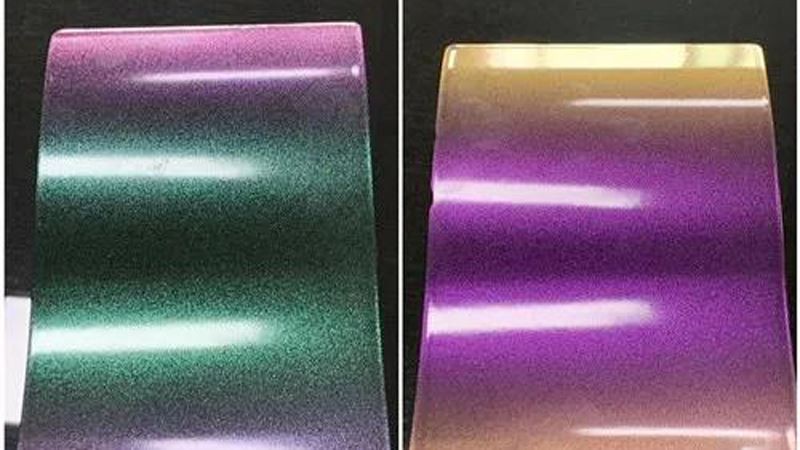
6. The allocation of colors:
Pearlescent pigments can be used in combination with ordinary pigments to create a variety of colors with bright colors and high color purity. Such as: phthalocyanine blue, phthalocyanine green, etc. It should be noted that too much colorant should be avoided, because excessive absorption of light color will cover the pearly light at the reflection angle.
7. Hiding power:
There are several ways to improve the hiding power in the formula: A: Pearlescent powder with fine particle size can improve the hiding power. However, the pearlescent effect is a softer satin effect, while the flickering effect is not obvious. To obtain the ideal pearlescent effect and covering power, a finer pearlescent powder can be used to replace a part of the coarser pearlescent powder. B: Adding metal powder to the paint can improve the hiding power, such as aluminum powder, copper powder, etc. The usual amount is 5-10% of the pearlescent pigment. C: When blending dark colors, a small amount of carbon black can provide good hiding power, and adding black can improve the reflection color of pearl. D: When mixing light colors, the use of titanium dioxide is also very helpful to increase the hiding power, but the pearlescent effect will be weakened, so if you want to use titanium dioxide, you must increase the amount of pearlescent pigments to enhance the reflected light color. However, the amount of titanium dioxide should be small and just enough for the hiding power. Remember: Opaque pigments or dyes will reduce the pearlescent effect. Summary: Pearlescent pigments are colorful, with soft satin luster, shimmering effect, and metallic luster. Formulate according to the following three principles. A better pearlescent effect can be achieved: 1. appropriate amount of pearlescent pigments to obtain many reflection/transmission surfaces, thereby producing a good pearlescent effect; 2. Try to arrange the pigments in parallel orientation to achieve better mirror reflection; 3. The lacquer should be transparent so that light can come and go freely and unimpeded.