




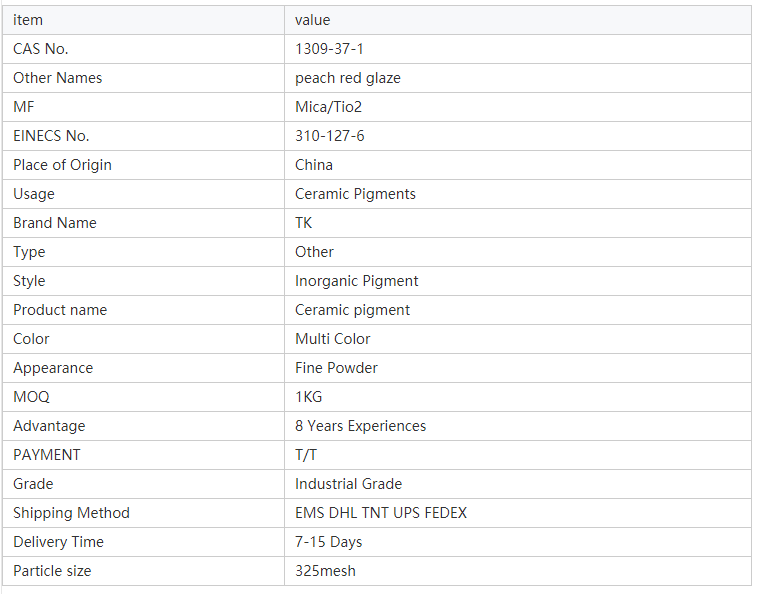
Ceramic colorants can be roughly divided into two types based on their intended use: glaze and body. Most of the glaze colorants have coloration in the body, but body colorants may not necessarily have coloration in the glaze. The main types of pigments used for red ceramic glazes include zirconium iron red, wrapped red, round red, manganese peach red, etc. Among them, zirconium iron red and wrapped red belong to the type of zircon structure, and have good hair color in both the body and glaze. Especially, wrapped red has bright hair color and high redness value. Although the price is relatively high, it is generally used more in glass mosaics, glazed porcelain pieces, and artistic ceramics; Zirconium iron red is widely used in matte glaze and ceramic tiles due to its relatively low price, ability to mix and color with other zirconium based pigments to create a rich range of colors, and good high-temperature performance.
Yuanzi red, also known as tin peach red, belongs to the structure of tin sphene. It is mainly made of chrome oxide, tin oxide and Calcium oxide. The formula of this product is highly confidential, the production process is complex, and the raw material selection and process are very careful. At present, it is also basically produced well in Chaozhou, Guangdong. It has been said that after the Chaozhou manufacturer set up a factory in Foshan, it prepared raw materials and the same raw materials and processes according to the original formula, but after coming to Foshan, it could not produce the original effect. It is also said that the production water is also exquisite. In addition, the way of introducing Calcium oxide in the formula is nothing more than Calcium bicarbonate or Calcium oxide. However, it is said that the Chaozhou region is not only crushed by oyster shells, Melt and stir fry with tin oxide ingots in a large pot, the process is both primitive and mysterious. According to the content change of chromium oxide and Calcium oxide in the formula, the color range of maroon extends from pink to deep purplish red. At present, Yuanzi red products are also used in the production of ceramic pink ink, and Chinese glazed roof tile is also a large user of it.
Manganese mahogany has poor temperature resistance at high temperature due to its Manganese(II) carbonate content, and pinholes are easily produced due to the presence of Manganese(II) carbonate in porcelain chips that are not fully reacted. Therefore, manganese mahogany for glaze is basically used in matt antique brick products.
The red ceramic pigment products used for the body mainly include coral red, ferrosilicon red, yttrium aluminum red, manganese red, etc. with aluminum iron structure. The development of aluminum iron red can be said to be a miracle, as this variety is said to have been accidentally developed in an experiment. It is also said that the miracle occurred because aluminum oxide was mistakenly used as chemical zirconia in the ball during the preparation of raw materials. Of course, the above statements are all legends in the Jianghu, but the first technical colleague to produce coral red products still greatly admires the author, who is also a technician.
Ceramic pigments are inorganic salts, i.e. metal compounds. The formation of its color is mainly due to the presence of colorable metal elements in its composition, and it needs to undergo several hundred or over a thousand degrees of barbecue to finally turn into color. Due to the limited number of metallic elements that can be colored after high temperatures, the types of ceramic pigments are also limited, and their color cannot be compared to painting pigments and organic printing pigments. When mixing colors, the principle of mixing is the same as that of organic printing pigments, but there are differences and cannot be rigidly applied. Ceramic pigments can be divided into high temperature and low temperature pigments according to their usage conditions. High temperature pigments refer to stable color development when used at temperatures ranging from 1000 to 1500 ℃, mostly used for glazes and billets; Low temperature pigments refer to those that exhibit stable color when used at temperatures ranging from 700 to 850 ℃, and are suitable for overglaze use. They are often used for screen printing, decals, and artistic porcelain painting, with slightly more color types than high-temperature pigments. Pigments with different temperatures cannot be matched and toned with each other, and pigments containing different metal elements are also limited in their matching and color matching.
Hot Tags: ceramic pigment peach red glaze pink special pigment underglaze color high-temperature 1200-1300, reducible firing, China, manufacturers, suppliers, factory, cheap, discount, quotation, low price, free sample


